


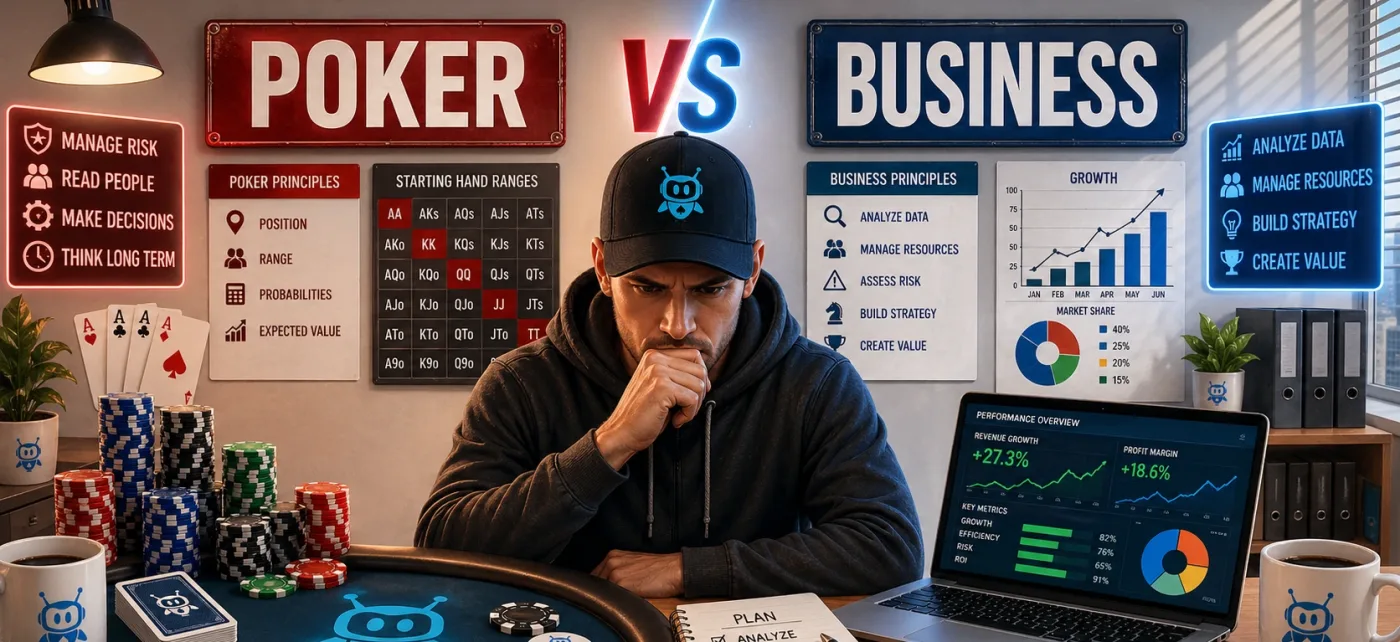
Poker and Business: Smarter Decisions
Introduction: The Real Link Between Poker and Business
Most people see poker as a game of cards and business as a game of products. In reality, both revolve around the same core skill: decision making under uncertainty.
This is why many business leaders, investors, and decision makers are drawn to poker. The game trains you to think clearly, manage risk, and choose between different courses of action without having complete information.
Tony Bloom represents this mindset perfectly. Tony Bloom built his career as a professional gambler and poker player, then applied the same decision making process to football.Today, Brighton stands out as one of the most efficient clubs in Europe, driven by consistent, data-driven decision making rather than luck.
As often highlighted when analyzing his model:
“Success comes from repeating strong decisions over time.”
This principle sits at the center of both poker strategy and business decision making.

Tony Bloom — Professional poker player and Brighton owner applying data-driven decision making
Poker as a Framework for Decision Making
Poker is not simply a game. It is a structured environment where players constantly make decisions with incomplete information. Every action has a potential outcome, and the objective is to select the option that performs best over time.
This creates a powerful decision making process based on logic rather than emotion.
In business, leaders face the same challenge. They must evaluate different strategies, weigh risks, and commit to a direction without certainty. The gap between average and high-level performance comes from the ability to make effective decisions consistently.
Poker accelerates this learning process because it provides fast feedback. Over time, players refine their thinking and improve their decision making skills.
Expected Value and Long-Term Thinking
Why Results Can Mislead Decision Makers
In poker, a correct decision does not always lead to a positive result in the short term. A player can make a strong move and still lose due to variance.
The same pattern appears in business. A company can execute a solid strategy and still face failure because of timing, competition, or market trends.
Strong decision makers understand this distinction. They focus on whether the decision was sound, not just on the final result.
“You control the decision, not the outcome.”
Building an Edge Through Informed Decisions
Tony Bloom’s approach relies on making informed decisions that deliver value over time. His strategy does not depend on winning every situation. It focuses on identifying opportunities where the long-term expectation is positive.
This is the foundation of strong business decision making. Companies that succeed are those that repeatedly make good decisions, even when short term results fluctuate.
Decision Making Under Uncertainty
Acting Without Complete Information
Poker players never see all the variables. They rely on patterns, ranges, and structured thinking to guide their actions.
Business leaders operate in the same environment. They must act without knowing how competitors will respond or how the market will evolve.
The goal is not certainty. The goal is to make the best possible decision with the information available.
Avoiding Cognitive Biases
Many decision makers struggle because of cognitive biases. Confirmation bias, overconfidence, or emotional reactions can lead to poor choices.
Poker helps reduce these errors. It trains players to stay rational, evaluate the potential impact of each action, and focus on logic instead of impulse.
“The advantage appears when others act emotionally and you remain disciplined.”
This is a key difference between average and high-level performance.
How to Manage Risk in Poker and Business
Survival as the First Objective
In poker, risk management determines whether a player can stay in the game. Losing all available resources means losing the ability to continue.
This principle applies directly to business. Poor risk management affects the bottom line and limits future opportunities.
Controlled Risk and Strategic Decisions
Many companies fail because they commit too much capital to a single idea or expand too quickly. The problem is not always the strategy, but the exposure to risk.
Tony Bloom’s model focuses on controlled decisions. Each move is measured, with attention to potential outcomes and downside risk.
“Staying in the game matters more than chasing fast results.”

Tony Bloom Professional poker player and Brighton owner known for data-driven decision making
This mindset allows both poker players and business leaders to survive volatility and build long-term success.
Data-Driven Decision Making vs Intuition
From Instinct to Structured Thinking
At early stages, decisions often rely on instinct. As complexity increases, intuition alone becomes unreliable.
In poker, advanced players use structured strategies based on data. They analyze patterns and rely on models to guide their actions.
In business, the same shift happens. Data-driven decision making becomes essential for making informed decisions and reducing uncertainty.
Finding Value Others Miss
Brighton’s strategy reflects this approach. The club focuses on identifying undervalued players and opportunities using data.
Instead of following trends, they search for inefficiencies in the market. This mirrors poker strategy, where players look for small edges rather than obvious plays You can explore this approach using tools like Optimus Poker Learn Mode, where decisions are analyzed using GTO principles.
“The best opportunities often come from areas others overlook.”
This is where long-term advantage is built.
Small Advantages and Long-Term Growth
Why Consistency Matters More Than Single Decisions
Success in both poker and business comes from consistency. One decision rarely defines the outcome.
In poker, players gain an edge by making slightly better choices across many situations. In business, companies improve results through better strategy, execution, and positioning.
Compounding Decisions Over Time
Each decision contributes to the overall result. Over time, these decisions compound and create a strong advantage.
Tony Bloom’s success follows this exact pattern. His results come from disciplined, repeated actions rather than isolated breakthroughs.
This is the foundation of sustainable performance in both poker and business.
Why Poker Builds Strong Decision Making Skills
Poker provides a unique environment for developing decision making skills.
Players must evaluate different scenarios, consider potential outcomes, and make rational decisions under pressure. The feedback loop is immediate, allowing continuous improvement.
These skills translate directly into business. Problem solving, risk management, and strategic thinking all improve through this process.
That is why many professionals use poker as a tool to sharpen their thinking.
Conclusion: The Same Principles, Different Context
Poker and business operate under the same structure. Both require clear thinking, strong decision making, and the ability to act under uncertainty.
Tony Bloom demonstrates how these principles can scale beyond the poker table. By applying a disciplined decision making process, he built success across different industries.
The takeaway is simple. Poker trains how to think, not just how to play. And in environments defined by uncertainty, strong decision making skills remain the most valuable advantage.