


How to Study GTO Poker Effectively
How to Study GTO Poker Effectively
Learning How to Study GTO Poker Effectively starts with a clear process. Poker hand rankings are easy to learn, but making strong decisions across thousands of poker hands is much harder.
Many poker players begin by opening a solver and trying to remember charts, bet sizes and exact percentages. This often creates confusion instead of progress.
A better poker study method follows a clear cycle:
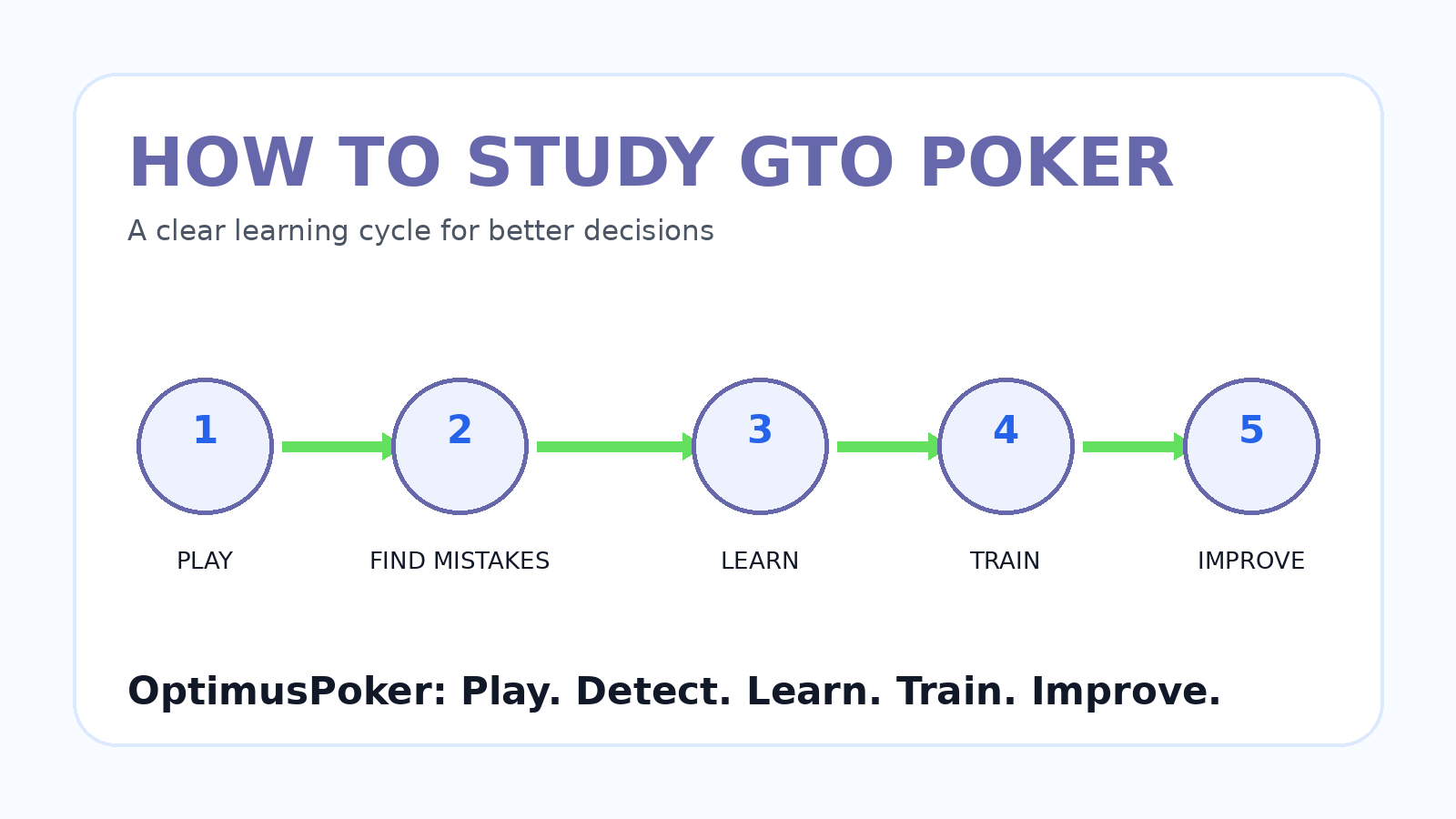 A practical GTO study cycle: play, find mistakes, learn, train and improve.
Play. Find mistakes. Learn. Train. Improve.
This guide explains how to study GTO poker with a simple study plan built around realistic practice and useful feedback.
What Is GTO Poker?
GTO means Game Theory Optimal.
A GTO strategy aims to stay balanced and hard to exploit. It considers your full range of hands, not only the two hole cards you hold.
A balanced strategy may include:
- Betting
- Checking
- Calling
- Raising
- Folding
- Changing the bet size
- Mixing more than one action
The best choice depends on your position, stack size, range, board and previous actions.
GTO does not mean choosing the same action every time. It means using optimal strategies that remain strong against many types of opponents.
GTO Goes Beyond Poker Hand Rankings
Before learning GTO poker, you should understand how poker hands are ranked.
A straight flush beats a full house. A full house beats a flush. A high card is usually one of the weakest hands.
In Texas Hold’em, players combine their hole cards with the community cards to build the strongest hand possible.
However, knowing poker hand rankings does not tell you when to bet or check.
You may check a strong hand to protect the rest of your range. You may bluff a weak hand because it blocks your opponent’s strongest calls. You may also use a check raise with strong hands, draws or selected bluffs.
GTO concepts focus on how your full range should play. Read our guide to what GTO means in poker for a deeper introduction.
“Hand rankings tell you what you have. GTO strategy helps you understand how your full range should play.”
Why Learning GTO Poker Feels Difficult
Poker strategy changes with every situation.
The correct play can depend on:
- Position
- Stack depth
- Cash game or tournament format
- Board texture
- Previous actions
- Pot size
- Bet size
- Starting ranges
A strategy used in a deep cash game may not work with a short stack. No-limit Texas Hold’em also requires different choices from limit hold’em.
Many players struggle because they study unrelated topics. Understanding how to study GTO poker means choosing one clear problem at a time.
They may watch a river-bluffing video, study a random flop and then review preflop ranges from another format. This creates information, but not a clear learning process.
GTO Strategy and Exploitative Poker
GTO gives you a balanced starting point.
Exploitative poker changes that strategy to punish an opponent’s mistakes.
For example, imagine that an opponent folds too often against river bets. You may bluff more often against that player.
However, random adjustments can create an exploitable strategy of your own. A safer process is:
| Step | Action |
|---|---|
| 1 | Learn the balanced strategy. |
| 2 | Find the opponent’s mistake. |
| 3 | Adjust with a clear reason. |
Understanding GTO helps you make better exploitative decisions in the long run.
Why Most Poker Study Plans Fail
Many study plans fail because they do not connect mistakes with future practice.
Studying Random Hands
Large pots often attract attention, but they are not always the best hands to review.
Study hands where:
- You felt unsure
- You considered several actions
- You chose a bet size without a reason
- You faced a check raise
- You acted too quickly
- You repeated an old mistake
Memorizing Exact Percentages
A solver may suggest betting 60% of the time and checking 40%.
Do not try to remember every number. Understand why both actions can work.
Watching Without Practising
Watching a video creates recognition. Making the decision alone requires recall.
You need both.
Judging Decisions by Results
You can lose after making the correct play. You can also win after making a bad one.
Focus on the decision, not one result.
How to Study GTO Poker With OptimusPoker
A practical answer to how to study GTO poker is to connect testing, playing, reviewing and training. OptimusPoker brings those steps into one study process.
Step 1: Take the Poker IQ Test
The Poker IQ Test gives you a clear starting point.
You make decisions across several poker hands, and your results can reveal weak areas such as:
- Preflop play
- Flop choices
- Turn strategy
- River decisions
- Bet sizing
- Calling and folding
The score is not a final judgment of your skill. Use it to answer one question:
“Which part of my game should I study first?”
That answer should guide your study plan.
Step 2: Practise in PLAY Mode
PLAY Mode lets you play full hands against opponents based on GTO strategy.
This matters because real poker requires decisions without showing you the answer first.
During each session, mark hands where:
- You did not know whether to bet or check
- You were unsure about the size
- You called without a clear reason
- You folded automatically
- You struggled against a raise
- You could not explain your action
These hands become useful study topics.
Step 3: Review the Full Situation
Do not review only your own cards. Think about both players’ ranges.
Ask:
- Who has the stronger range?
- Who has more very strong hands?
- Which hands bet for value?
- Which hands make good bluffs?
- Which hands prefer checking?
- Which size fits the situation?
- Which cards block strong calls?
Imagine that you checked a medium-strength hand, but the recommended play is to bet.
Always bet this hand.
This hand can bet because weaker hands may call and several better drawing hands may fold.
That lesson works in more than one situation.
Step 4: Compare Similar Poker Hands
One hand rarely teaches a full concept.
Compare similar boards with the same positions and ranges.
After the button raises and the big blind calls, compare:
- Dry ace-high flops
- Connected flops
- Paired boards
- Boards with cards of the same suit
- High turns
- Low turns
- Cards that complete a straight or flush
You may find that the raiser can bet more often on dry boards.
On connected boards, the big blind may hold more two-pair combinations, draws and strong hands. The raiser may need to check more often.
This comparison helps you learn patterns instead of isolated answers.
Step 5: Save One Clear Lesson
Do not save every chart or percentage. Write one short note after each session.
A useful note should include:
- The situation
- The main pattern
- What to remember
“Button versus big blind: use small bets more often on dry ace-high boards. Check more on connected boards where the big blind has more strong hands and draws.”
Short notes are easier to review and apply.
Step 6: Practise in TRAIN Mode
Understanding a mistake does not always correct it.
TRAIN Mode asks you to make decisions and gives feedback after each hand.
This active practice can help you:
- Recognize common spots
- Improve decision speed
- Remember range patterns
- Practise several bet sizes
- Reduce repeated mistakes
- Improve play across each street
After a mistake, stop before moving on. Ask:
- Did I value my hand too highly?
- Did I fold too often?
- Did I choose the wrong size?
- Did I miss a value bet?
- Did I ignore a blocker?
- Did I bluff with the wrong hand?
The goal is not only to improve your score. You also need to understand the reason.
Step 7: Return to PLAY Mode
After reviewing and training, return to realistic play.
Try to apply the lesson without checking your notes. Ask:
- Who has the stronger range?
- Which hands want to bet?
- Which hands prefer checking?
- Which size should I use?
- What happens after a call?
- Can I explain my choice?
You have learned the concept when you can use it naturally.
The Best Study Routine
If you are wondering how to study GTO poker without spending hours at a solver, try this focused 30-minute routine:
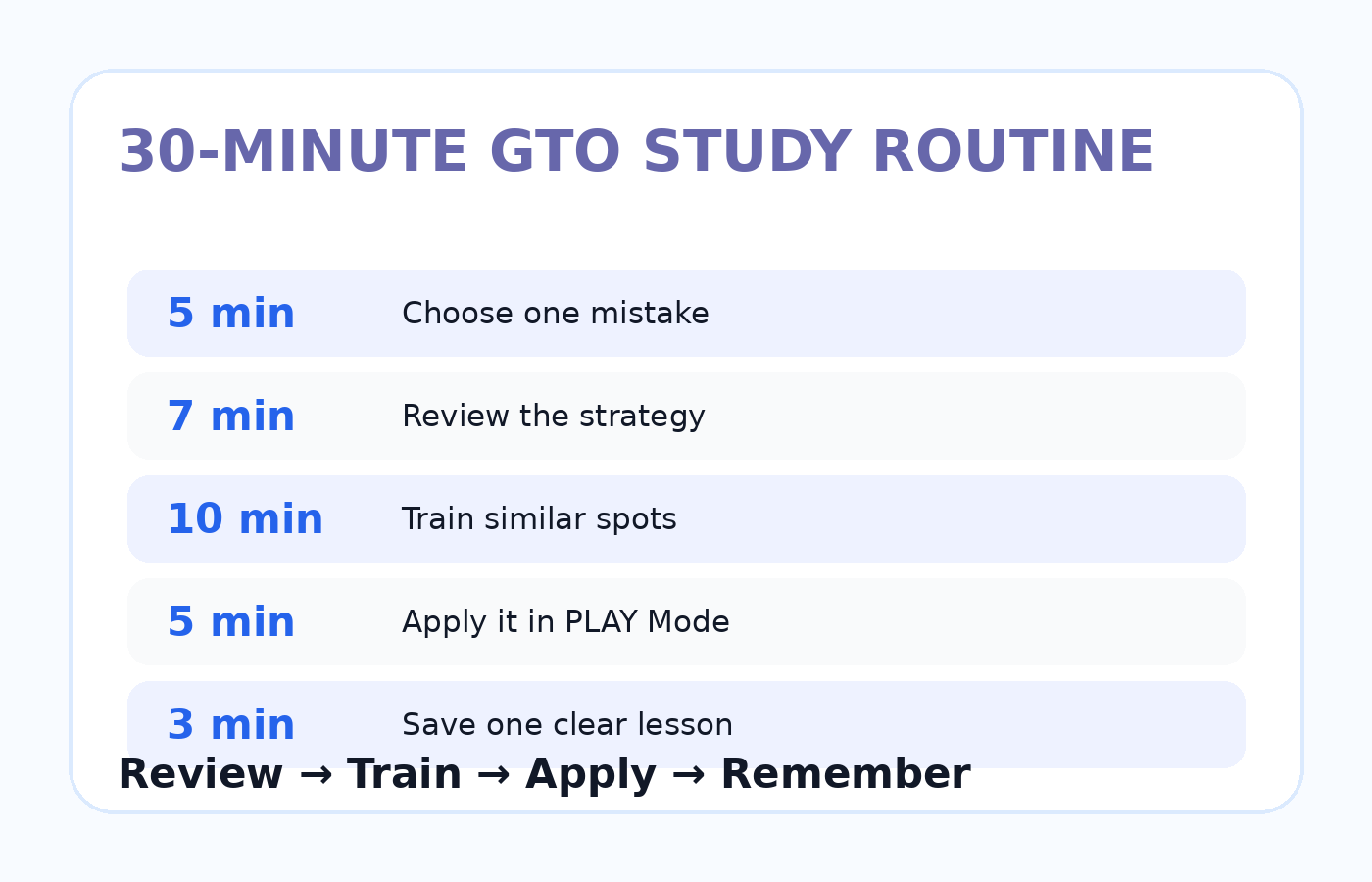 A simple 30-minute study plan built around review, training and realistic play.
| Time | What to Do |
|---|---|
| First 5 minutes | Choose one mistake from the Poker IQ Test, PLAY Mode or TRAIN Mode. |
| Next 7 minutes | Review the strategy and find the main difference between your choice and the recommended play. |
| Next 10 minutes | Train similar situations. Stay on the same topic. |
| Next 5 minutes | Return to realistic play and look for the same pattern. |
| Final 3 minutes | Save one short lesson. |
This is the best study routine for players who want steady progress without random study.
What Beginners Should Study First
Beginners should focus on:
- Position
- Opening ranges
- Big blind defence
- Three-betting
- Pot odds
- Value betting
- Common flop types
- Simple bet sizes
- Responses to raises
Do not begin with complex river mixes.
First learn why a hand bets, checks, calls or folds.
What Experienced Players Should Study
More experienced players should focus on repeated weaknesses.
Useful topics include:
- Turn and river play
- Bet-size selection
- Bluff construction
- Blockers
- Check-raise ranges
- Multi-street planning
- Cash game formations
- Exploitative adjustments
Choose precise questions. Instead of studying “river strategy,” study:
“How should the button respond when the big blind check raises a low connected flop?”
Clear questions create better sessions.
Why Use OptimusPoker?
The platform connects:
- PLAY Mode
- TRAIN Mode
- The Poker IQ Test
- Solver-based strategy feedback
- Poker notes
- Progress tracking
This helps you answer four questions:
| 1 | What did I do? |
| 2 | What was the better action? |
| 3 | Why was it better? |
| 4 | How can I practise it? |
Instead of moving between separate tools, you can follow one process based on your own decisions.
Find the areas you need to improve and build your next poker study plan around your own decisions.
Frequently Asked Questions
How to study GTO poker effectively?
Combine realistic play, strategy review and targeted training. Focus on one common situation at a time.
Can beginners learn GTO poker?
Yes. Start with position, preflop ranges, value betting and common flop spots.
Should I use a solver or a trainer?
Use a solver to understand the strategy. Use a trainer to practise the decision.
How long should a poker study session last?
A focused session of 20 to 40 minutes can work well. Consistency matters more than long sessions.
Does GTO work in cash games?
Yes. GTO concepts apply to cash games and tournaments, but ranges and strategies change with the format and stack depth.
How can OptimusPoker help?
It connects realistic play, testing, feedback, training, notes and progress tracking within one study plan.
Final Thoughts
Knowing how to study GTO poker matters more than memorizing thousands of solver results.
You need a clear process.
Play poker hands. Find your mistakes. Understand the strategy. Save the lesson. Train the decision and apply it again.
Over the long run, better decisions create better results.
Take the Poker IQ Test, find the areas you need to improve and build your next study plan around your own decisions.